SRP Electric Blog

Author Archive

Where can I buy an electric vehicle in Peterborough, ON?

Posted in: Green on September 8th, 2013

volt-electric-car

Electric vehicles can be purchased at most major car dealerships. A sample of these dealerships include:

Car: Chevrolet (Volt)

Dealer: Curry Chevrolet Buick GMC Ltd. located at 5065 County Road 21 Haliburton, ON K0M 1S0 — website www.currymotors.ca.


Car: Ford (Focus Electric)

Dealer: Holiday Ford Lincoln located at 1555 Lansdowne Street West, Peterborough, ON K9J 6Z3 — website www.holidayford.com.


Car: Nissan (Leaf)

Dealer: Trans Canada Nissan located at 1189 Lansdowne St W  Peterborough, ON K9J 7M2 — website  http://www.usedcarcity.net/index.htm


Car: Mitsubishi (i-MiEV)

Dealer: Peterborough Mitsubishi located at 2071 Lansdowne Street West, Peterborough,  ON  K9J 6X4 — website

http://www.peterborough-mitsubishi.ca/home.aspx?lng=2


Car: Tesla (Model S)

Dealer: Teasla Motors located at 3401 Dufferin Street Toronto ON M6A 3A1 Canada — website  http://www.teslamotors.com/en_CA/yorkdale


Please don’t hesitate to contact us for more information or if you have any questions!

How much does it cost to replace a battery, and How long does the battery pack last?

Posted in: Green on September 1st, 2013

Most auto manufacturers warranty the battery for 8 years and there are even extended warranties available too.

Because the battery pack is under warranty for 8 years you aren’t likely going to be buying a new battery pack any time soon. Let’s pick a number though, say $15,000 to buy a new battery at current prices, and let’s say in the 9th year, you have to replace the battery. We know 3 things about lithium-ion and other evolving batteries types. Eight years down the road they will be;

i) lighter weight,

ii) have much greater power density,

iii) less expensive.

With the way battery technology is evolving, chances are very good that you will be able to get a battery for 1/3 the present cost and quite likely it will provide triple or greater range and your vehicle will be lighter weight, all providing further opportunities for savings.

Battery Acceptance / Receptivity Rates

Note to EV owners and soon-to-be owners:  Your Vehicle Acceptance Rate will determine what type of EV charging station you will choose to install at your home or business.  Depending on your vehicle’s needs, some stations will be ‘overkill’ and make no difference in the time it takes to charge your vehicle (note the yellow highlights in the chart below).  Other charging stations won’t be enough to charge overnight. SRP Electric will be pleased to assist you in this regard!

Battery Acceptance Examples

battery acceptance


A)    A Toyota Rav4 EV charging with an LCS-25 charging station with 240V:
Check the Vehicle Acceptance Rate versus the Charging Station Delivery Rate for the LCS-25.  Which is lower?  That will be your limiting factor.  Vehicle Acceptance Rate of the Toyota Rav4 EV is 9.6 kW.  The LCS-25 Delivery Rate is 4.8 kW.  Use 4.8 kW because it is the lower of the two numbers (this is the maximum power the charging station can deliver to the vehicle).
Divide the battery capacity by the lower number from above.  Divide 41.8 kWh by 4.8 kW from above.  The result is 8.71 hours to recharge the battery pack from empty to full.

B)     A Toyota Rav4 EV and a CS-50 charging station with 240V:
Check the Vehicle Acceptance Rate versus the Charging Station Delivery Rate for the CS-50.  Which is lower?  That will be your limiting factor.  Vehicle Acceptance Rate of the Toyota Rav4 is 9.6 kW.  The CS-50 Delivery Rate is 9.6 kW.  Use 9.6 kW because both are the same (it is both the maximum the vehicle will draw and the maximum power the charging station is capable of delivering).
Divide the battery capacity by the lowest number from above.  Divide 41.8 kWh by 9.6 kW from above.  The result is 4.35 hours from empty to full.

Government programs and incentives available for Electric vehicles

Posted in: Green on August 27th, 2013

green EVThe Ontario government launched its Electric Vehicle Incentive Program in 2009 with the aim of insuring electric cars will represent one out of every 20 cars on the road by 2020.

The program offers buyers or leasers of new electric cars varied incentives. As of July 1st, 2010, Ontario drivers are eligible to receive $5,000 to $8,500 toward their next purchase or lease of a new plug-in hybrid electric or battery electric vehicle.

The value of the incentive is based on the vehicle’s battery capacity, which ranges from $5,000 for a 4kWh battery to $8,500 for a 17kWh battery. In order to be eligible for the incentive, personal electric vehicles must be registered and plated in Ontario for a minimum of 12 months.

More information can be found by visiting the Ontario Ministry of Transportation
Ontario individuals, businesses, and organizations that purchase or lease a new plug-in hybrid electric or battery electric vehicle after July 1, 2010 may be eligible for a rebate between $5,000 and $8,500.

More Information on this program — source –:

The EV incentive program is open to persons, businesses, municipalities, non-government organizations and non-profit groups. Applicants can receive incentives for no more than five vehicles per calendar year.

Leased vehicles are eligible for an incentive depending on the term of the lease and whether the vehicle is used for personal or fleet purposes. To qualify for the full value of the incentive, a minimum 36-month lease term is required. If vehicles do not meet the specified term requirements, the incentive payment must be repaid in full.

To qualify for the incentive, EVs for personal use must be registered and plated in Ontario for a minimum of 12 months. Fleet vehicles must be registered and plated in Ontario for a minimum of 36 months to qualify for the program.

Eligible electric vehicles purchased in another jurisdiction can qualify for the incentive only if the registration of the vehicle in Ontario is the first time the vehicle has been registered in any jurisdiction. Vehicles that have been registered in other jurisdictions prior to Ontario do not qualify for the incentive.

If vehicles do not meet the residency requirements for the specified term, the incentive payment must be repaid in full.

There are two ways to receive the incentive. The automobile dealer can apply the incentive at the point-of-sale and then submit the incentive application on your behalf. Alternatively, you can purchase the vehicle at full price and apply directly for the incentive by completing the application form and submitting it to the Ontario Ministry of Revenue.

The incentive is applied to the after tax value of the vehicle. In the case of a leased vehicle, the monthly principle amount will reflect the reduced cost of the vehicle.

Download the incentive application form.

Consult the list of eligible vehicles and incentive values

If you are a vehicle manufacturer, download an application to qualify your vehicle for the Electric Vehicle Incentive Program

How much does it cost to replace a battery, and How long does the battery pack last?

Posted in: Green on August 18th, 2013

Most auto manufacturers warranty the battery for 8 years and there are even extended warranties available too.

Because the battery pack is under warranty for 8 years you aren’t likely going to be buying a new battery pack any time soon. Let’s pick a number though, say $15,000 to buy a new battery at current prices, and let’s say in the 9th year, you have to replace the battery. We know 3 things about lithium-ion and other evolving batteries types. Eight years down the road they will be;

i) lighter weight,

ii) have much greater power density,

iii) less expensive.

With the way battery technology is evolving, chances are very good that you will be able to get a battery for 1/3 the present cost and quite likely it will provide triple or greater range and your vehicle will be lighter weight, all providing further opportunities for savings.

Battery Acceptance / Receptivity Rates

Note to EV owners and soon-to-be owners:  Your Vehicle Acceptance Rate will determine what type of EV charging station you will choose to install at your home or business.  Depending on your vehicle’s needs, some stations will be ‘overkill’ and make no difference in the time it takes to charge your vehicle (note the yellow highlights in the chart below).  Other charging stations won’t be enough to charge overnight. SRP Electric will be pleased to assist you in this regard!

Battery Acceptance Examples

battery acceptance

 A)    A Toyota Rav4 EV charging with an LCS-25 charging station with 240V:

Check the Vehicle Acceptance Rate versus the Charging Station Delivery Rate for the LCS-25.  Which is lower?  That will be your limiting factor.  Vehicle Acceptance Rate of the Toyota Rav4 EV is 9.6 kW.  The LCS-25 Delivery Rate is 4.8 kW.  Use 4.8 kW because it is the lower of the two numbers (this is the maximum power the charging station can deliver to the vehicle).
Divide the battery capacity by the lower number from above.  Divide 41.8 kWh by 4.8 kW from above.  The result is 8.71 hours to recharge the battery pack from empty to full.

B)     A Toyota Rav4 EV and a CS-50 charging station with 240V:
Check the Vehicle Acceptance Rate versus the Charging Station Delivery Rate for the CS-50.  Which is lower?  That will be your limiting factor.  Vehicle Acceptance Rate of the Toyota Rav4 is 9.6 kW.  The CS-50 Delivery Rate is 9.6 kW.  Use 9.6 kW because both are the same (it is both the maximum the vehicle will draw and the maximum power the charging station is capable of delivering).
Divide the battery capacity by the lowest number from above.  Divide 41.8 kWh by 9.6 kW from above.  The result is 4.35 hours from empty to full.

How much does an electric vehicle cost?

Posted in: Residential on August 10th, 2013

table_cost_electric_carsNOTE: Data on this image are those for the US but they mirror those offered by the Ontario Government. Please contact us for details  and for clarification.

Aren’t Electric Vehicle’s expensive to buy though?

The cost upfront for an electric vehicle is typically higher than a comparative internal combustion engine (ICE) vehicle, but that is only looking at part of the picture. The price for an electric car ranges between $20,000 and $200,000 but in certain provinces you can get up to $8,500 back from the provincial government on the purchase of an electric vehicle. In certain provinces, when you buy an EV, you can also save 50% of the cost of a home/workplace charger including the install or up to $1,000, whichever is lesser amount.

Fleet Managers that are responsible for purchasing and maintaining dozens, hundreds or even thousands of vehicles, are very excited about EVs from a cost savings standpoint. Why? Because they understand TCO or Total Cost of Ownership!

TCO = the price of the vehicle + the price of fuel + maintenance costs

On average, people keep their vehicle for 8 years before trading it or selling it. Over this period EVs can really save owners a lot of money because EVs have fewer moving parts to replace and with an all electric vehicle like a Nissan Leaf for example, there are no oil or filter changes. Because of regenerative braking on EVs, the brakes also last much longer – saving you money in the long run.
So the reality is – an EV can be significantly less to own than conventional vehicles.

On Tuesday Tuesday, Jun. 11 2013, ‘The Globe and Mail’ published an article on how electric-car makers are lowering prices in a race to catch Toyota’s Prius.

To summarize the article:

Nissan Canada Inc. offers a lower-priced version of its Leaf when the 2013 model goes on sale. General Motors of Canada Ltd. offered a seven-year, interest-free loans on the Chevrolet Volt in June 2013. Mitsubishi Motor Sales of Canada Inc. is offering incentives of $5,000 and $8,000 on the two versions of its i-MiEV electric car (NOTE: these sales may still be on or may have expired – check with respective dealers).

The price war comes as new competitors enter what at the moment is a tiny segment of the Canadian market, but one that is expected to grow as auto makers diversify their engine offerings to meet stringent new standards for emissions and fuel economy that will start coming into force in 2017.

Nissan Canada, whose parent Nissan Motor Co. Ltd. has made a multibillion-dollar bet that electric vehicles will be the main alternative to internal combustion-powered cars and trucks, will offer a new, S version of its five-passenger Leaf for $31,698. The SV version, which was the lowest-priced model in 2012 at $38,395, will cost $34,998, a drop of 9 per cent.

The 2013 price includes a quick charger, which was an optional extra on the 2012 SV model. Sales of Leaf models doubled in the first five months of 2013, to 235 from 117 in the same period a year earlier.

Sales of the $42,000 Chevrolet Volt, which is not a pure electric vehicle, slumped 25 per cent in the first five months of the year – to 318 from 421 a year earlier – and plunged 63 per cent in May in Canada

—  Source: ‘The Globe and Mail’ — Published Tuesday, Jun. 11 2013, 7:23 PM EDT —

Since battery packs are more expensive to produce than combustion engines, the upfront cost of purchasing an electric vehicle tends to be substantially higher than that of a traditional gasoline-operated vehicle.

What are the sales numbers?

David W. Rowlison, the Director for National Dealer Development at Sun Country Highway provided us this data and noted:

“Further to recent discussions – here’s some good info on EV numbers in North America. While this mainly addresses USA based numbers, it is as earlier stated widely regarded that on a per capita basis, Canada is actually ahead of the US by about 10-15%… We again suspect it has something to do with the fact that Canadians are more ‘predisposed’ – as they are and always have been with small – more fuel efficient cars in general, to entertaining electric / hybrid vehicles.”

June-electric-vehicle-sales

How long does it take to charge an Electric Vehicle, and what is the cost?

Posted in: Green on August 3rd, 2013

subLEAF

The length of time required to charge an electric vehicle depends on the voltage of the outlet or charging point used as well as the size of the vehicle itself. A smaller car can be plugged into a standard 120-volt household outlet, but may take up to 12 hours to charge. A larger vehicle may require an outlet up to 220 volts.

Conversely, if an electric vehicle is plugged into a home or public charging station, it may require as few as two hours to charge the battery completely.

So how long does an EV take to charge up an EV?

There are 3 levels of charging – Level 1, Level 2 and level 3.

Level 1 – Using the 15 amp — 110V household plug:

– Chevy Volt takes about 12.1 Hrs to charge

– Nissan Leaf takes about 18.2 Hrs to charge

– Ford Focus EV takes about 17.4 Hrs to charge

– and the Mitsubishi takes about 12.1 Hrs to charge

Level 2 – Using the >25 amp —  240V delivery rate: 

– Chevy Volt takes about 3.3 Hrs to charge

– Nissan Leaf takes about 5.0 Hrs to charge

– Ford Focus EV takes about 4.8 Hrs to charge

– and the Mitsubishi takes about 3.3 Hrs to charge

The fastest charging is Level 3 or ‘DC Fast Charging’:

This will charge a battery up to 80% in only 25-45 minutes. Soon, you will see many more of these chargers along the 401 and other routes across Canada to compliment our high speed level 2 chargers. However, costs are substantial – these units range between $25,000 and over $100,000.

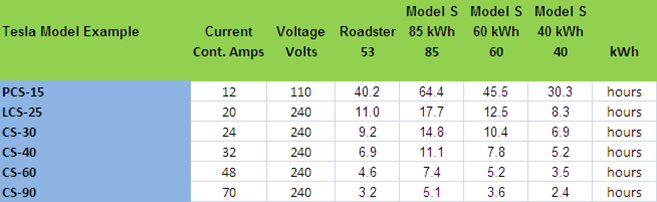
Why 90 amp Charging Makes Sense:

chart

All this said, what  we need to note is that 80-90% of Charging is done at home or at work and at night. So every day when you get home from work, school, shopping etc, you plug in. The next morning – Voila! You have a full charge and are ready to go. Now you can’t have a gas station at your home, the government won’t let you, but you can have an electric vehicle charging station at home!
In Canada, almost 90% of the population travels less than 60 km per day on their return trip to work. So you never really have to worry about running out of electricity.

acceptance rate


Top image  source

How far can I drive on a single Electric Vehicle charge?

Posted in: Green on July 27th, 2013

distance EVDistance is very important. But you will agree that even conventional cars have limited range too. The only difference which is an added advantage is the abundance of gas stations at specific distances to fuel up.

Data indicate that 80 percent of normal drivers drive less than 60 km a day, which means that charging every night (or every few nights), will get us to work and back with a few errands in between (reference). So for distances above say 100 Km to -– we need some sort of charging infrastructure.

The cruising range of an electric vehicle depends on a variety of factors, including the size of the battery, the model of the car, the road conditions, as well as the way the vehicle is driven.

Poor weather, either extreme heat or cold, can cause battery performance to decrease, resulting in less mileage. Similarly, internal climate control mechanisms such as heating and air conditioning can drain the battery significantly and reduce the distance the car is able to travel between charges.

However, these factors aside, average family-car size vehicles typically range about 100 km per charge.

Back to the question on how far do EV’s go on a charge?

The Ford Focus EV and the Nissan Leaf with bigger battery packs travel up to about 24KM on a single charge, while the Chevy Volt and the Mitsubishi i-MiEV travel lower KMs at 16KM due to smaller battery packs. The Tesla Roadster goes up to 380 kms on a charge while the Tesla Model S Motor Trend Car of the Year goes up to 480 kms. So on the Model S seven seater sedan, you can drive as far as from Toronto to Ottawa on a single charge. Plus it does 0-100 kms/hr in 3.9 seconds! Now a Chevy Volt has a total combined electric and gas range of over 550 kms so there are vehicles for almost every scenario and getting better every day.

Sun Country Highway’s Via Motors / VTrux units however use Extended Range Electric Vehicle (EREV) technology -somewhat similar to a Chevy Volt. These vehicles get 60-65 kms of range in pure electric mode before the on board gas engine and generator kick in to replenish the battery pack and give you a combined electric and gas powered range of ~650 kms. And the best part is you get up to 100 mpg or 1.5lt/100 kms fuel economy.

The important thing to think about is to purchase a vehicle that satisfies 98% of your driving needs. Many people say “but when I want to drive from Toronto to Quebec City what do I do, an EV can’t go that far”? True, a pure electric car may not be practical for very long trips, but how often does the average person take such trips, one, two or maybe three times per year? Within a year, one will be able to find Fast level II or Level III DC Quick Chargers almost everywhere!

Image source


How does an Electric vehicle work?

Posted in: Green on July 20th, 2013

diagram-electric-vehicle

Electric cars can be found every where today, and show up in the news all the time.

Electric Vehicles (EVs) originated in the mid-19th century as electricity had become the most popular method for motor vehicle propulsion. This provided a level of comfort and ease of operation that could not be achieved by the gasoline cars of the time (reference).

The major difference between a gasoline and an EV are:

– The gasoline engine is replaced by an electric motor.
– The electric motor gets its power from a controller.
– The controller gets its power from an array of rechargeable batteries.

All electric vehicles contain the following components:

– Multiple rechargeable batteries
– At least one electric motor
– A controller that connects the motor to the accelerator pedal
– A charging system

The rechargeable battery provides electricity to the motor, which in turn controls the vehicle’s transmission. When the vehicle’s battery needs to be charged, it can be plugged into a standard household outlet (which may take up to 12 hours to charge depending on the outlet voltage), a specialized home charging system, or a public charge station connected to a community power grid.

Check this out!

1) By choosing to buy and EV, you save yourself a lot of money because we already know we can literally drive all the way across Canada for FREE and the cost to charge up is 1/8 that of fuel for a gas powered vehicle. So how much can you save in your local metropolitan area?

2) You helped save the environment and helped reduce healthcare costs!

3) Plus, you further helped sustain the economy on 2 levels – by employing an electrician and ensuring jobs for regional utility workers.

How does it get any better than that?

Well think about not having to pump gas in the freezing cold and how nice it is to leave your house every day with a full charge. There is also no need to search for a gas station without a line-up on route to work in the morning.

Our partnership with Sun Country Highway brings the World’s Longest/Greenest Highway Project to your doorstep. Sun Country Highway now has hundreds of chargers installed across Canada mainly on the Trans-Canada and 400 series Highways, with a goal to have over 1,000 chargers or more in place reaching out to 95% of Canadians.

Image source


What is an Electric Vehicle?

Posted in: Green on July 13th, 2013

hybrid-car-hyperAccording to the Ontario Ministry of Transportation website, an electric vehicle (EV) is a vehicle that is powered by electricity and contains a battery to store energy. Electric vehicles use one or more electric motors or traction motors for propulsion.

There are EVs that are directly powered from an external power station, others that are powered by stored electricity from an external power source, and those that are powered by an on-board electrical generator, such as an internal combustion engine (a hybrid electric vehicle) or a hydrogen fuel cell.

In detail, EVs rely on one of three types of technology:

1. Conventional hybrid technology (HEV), in which the vehicle’s transmission is controlled by both a gasoline engine and fuel tank, and an electric motor and battery. All of the vehicle’s power comes from the gasoline.

2. Plug-in hybrid technology (PHEV), which relies primarily on a battery and electric drive train but is also supported by an internal combustion engine that recharges the battery when the power is low.

3. Battery electric technology (BEV), which operates entirely on a battery and electric drive train and requires regular charging from an external power source.

Now think about this… Where does the energy come from to power an electric car? The electrical grid right! That means renewables like solar, wind, geothermal and other sources like hydro—even nuclear! As you may be aware, many parts of Canada (i.e. Ontario, Quebec and BC) are ‘flush’ with electric power at night – in the hours when there is minimal draw on our hydro-electric grids. Utilizing this ‘glut’ of available energy – which we are so often giving away to the USA to charge our EVs makes absolute perfect sense form an energy cost and strategy standpoint!

All these are regionally produced sources of energy and this means jobs for your family, friends and neighbours. So there is no need to import fossil fuels from the Middle East or from Calgary. No need to import any carcinogens either! And you help ensure good jobs for engineers and power workers at your regional energy distribution company by driving an EV.

Image source

SRP Electric Partners With Sun Country Highway To Role Out Electric Vehicle Charging Stations In Peterborough, ON

Posted in: Green on July 3rd, 2013

SRP Electric — Central Ontario’s choice for electrical contracting with over 20 years of electrical engineering and exceptional customer service has partnered with Sun Country Highway. This partnership aims to facilitate, and rapidly accelerate the adoption of electric vehicles and lower carbon emissions in the transportation sector here in Peterborough. This partnership also brings with it competitively priced advanced technology products to help drive sustainable revenues for local businesses.

Local Businesses in the Peterborough and the Kawartha Lake areas looking to embrace the green initiatives sweeping Ontario today are invited to get on board. We are ready and rolling out programs to begin helping local businesses generate clients, and give their business a ‘green’ image at the same time. The number of electric vehicle owners in Ontario is rapidly growing and we have joined Sun Country’s goal to put over 1,000 chargers on-line by the end of this year.

Its no secrete that Ontario’s electricity sources produce very low greenhouse gasses, and is also inexpensive. Data indicate that an electric vehicle can be charged at about 1/6th the price of gas at night during off-peak hours. We’ll discuss more on the efficiency and cost effectiveness of using electric vehicles in a later update, but note that no matter where you are in Canada, electric cars offer both environmental and economic benefits. The extent of these benefits will vary from one region to another depending on the sources of electricity generation and the local prices of gas and electricity.